Geophysical Insights | Paradise | The AI Workbench for Reservoir Characterization
Plan with Intelligence. Drill with Confidence.
Your AI Journey Starts Here
Impact by Discipline
Your AI Journey Starts Here
Paradise is an AI workbench for reservoir characterization. It combines multi-attribute machine learning, deep learning and guided ThoughtFlows so geoscientists and reservoir engineers can investigate stratigraphy, predict lithofacies, detect faults and estimate geobody volumes from seismic and well data, for exploration, field development and carbon storage evaluation.
Spend less time looking for the answers and more time putting those answers to use.
The Paradise AI Workbench allows you to:
Extract more geological details through machine learning vs traditional methods
Produce higher resolution interpretations of reservoirs and their geologic features
Detect faults and classify seismic facies automatically while reducing uncertainty
Integrate faults with stratigraphic analysis for a more complete structural understanding
AI-Enabled Reservoir Characterization
The short videos below offer quick insights into how geoscientists and reservoir engineers are using Paradise to extract more from seismic data, produce more accurate results, and dramatically decrease the time spent in workflows.
“By using Lithofacies Prediction in Paradise, I generated 3D geobodies of lithofacies in 12 hours what it would have taken me three weeks using traditional inversion tools.”</h65
Robin Dommisse
Senior 3D Geological Modeling Advisor, Bureau of Economic Geology at the University of Texas at Austin
“This study demonstrates a clear improvement in reservoir characterization compared to the traditional QI approach.”
Sharareh Manouchehri
Principal Geophysicist at INPEX Idemitsu
“Now, what Paradise allows us to do is, it’s kind of like an enhancement of the resolution that we already had after doing all the reprocessing of the seismic data. This allows us to take a much closer look at the attributes that we typically see for oil and for gas within the seismic, and we can control that by looking at the wells that we already have in the blocks.”
Jeremy Asher
CEO of Tower Resources
“In addition to the standard oil and gas projects, our consulting group uses Paradise on many ‘outside-of-the-box’ applications. With Paradise, I can look at a lot of data efficiently and quickly to determine which seismic attributes contribute the most information. Paradise gives us an edge.”
Judy Schulenberg
Principal of Explorer Group 1
“SOMs find facies patterns first, which can then be labeled by the geologist using log data or geologic analogs. The flexible nature of SOMs makes them a useful unsupervised approach for seismic facies analysis, particularly where there may be limited well control.”
Dr. Heather Bedle
Assistant Professor at the University of Oklahoma & Principal Investigator for the Attribute-Assisted Seismic Processing & Interpretation (AASPI) Consortium
“It was advantageous to use unsupervised ML classification of multi-attribute seismic samples because the technology is highly effective at revealing stratigraphic patterns in a complex structural setting.”
Deborah Sacrey and Camilo Sierra
Systematic Workflow for Reservoir Characterization in Northwestern Colombia using Multi-attribute Classification, First Break, 2020
“Anyone who is involved in prospect evaluation and reservoir characterization should have no problem seeing evidence of the stratigraphic and reservoir facies details that a properly constructed multi-attribute classification can provide.”
Dr. Bob Hardage
Former SEG President
“We continue to find new insights in the Utica play using the Paradise AI workbench. The results corroborate nicely with ground truth. Using machine learning is now a key part of our interpretation workflow.”
Randall Hunt
Former Staff Geophysicist, Range Resources
Step 1: Discovery Call – Schedule Now
Schedule your introductory call to discuss what AI can do for you.
Start your AI implementation journey today with a short, 30-minute introductory call. We will listen carefully to your objectives and design a path for your team that realizes tangible benefits.
I have a specific problem I'm trying to solve.ⓘ Click anywhere outside of this popup to close.
Geophysical Insights staff work in a variety of depositional environments across the globe. We're delighted to be a trusted partner in your AI journey, whatever the challenge. Please schedule a brief get-to-know you call using Calendly below, where we can dive into your specifics.
I'm considering AI for my subsurface group.ⓘ Click anywhere outside of this popup to close.
A great way to start with adopting AI for your team is to define a reasonable objective that addresses current challenges. In the case of applying the Paradise AI workbench to reservoir characterization, those challenges will be geologic and related to seismic interpretation. Here are some key questions you may want to consider as a guide to your adoption process:
What might be the business case for adopting AI software for seismic interpretation, e.g., speed, staff efficiencies, greater insights?
How well do the candidate software products align with my highest-value workflows and results, e.g., predicting lithologies, detecting faults, and identifying seismic facies?
Do you want your team to experience the power of AI for themselves, or do you want a service provider to generate the initial proof of concept for your team?
Does your company have the computing equipment and storage available to run the AI software, which can be compute-intensive and require extensive data storage?
I'm new to AI for Reservoir Characterization.ⓘ Click anywhere outside of this popup to close.
In seismic interpretation workflows, AI is a general class of technologies that include machine learning (ML) and deep learning (DL) applications. Commercial, off-the-shelf tools like those in the Paradise AI workbench are fit-for-purpose, meaning they support specific geologic investigations. For comparison, Python is a programming environment that offers ML and DL processes. Large language models (LLMs) like ChatGPT can be used to generate Python code, among many other functions. Developers often use Python and ChatGPT together to prototype applications. In Paradise, ML, DL, and data analytic applications are pre-built and organized in workflows (ThoughtFlows®) that address out-of-the-box solutions not requiring programming, such as Stratigraphic Analysis, Lithofacies Prediction, and Fault Detection.



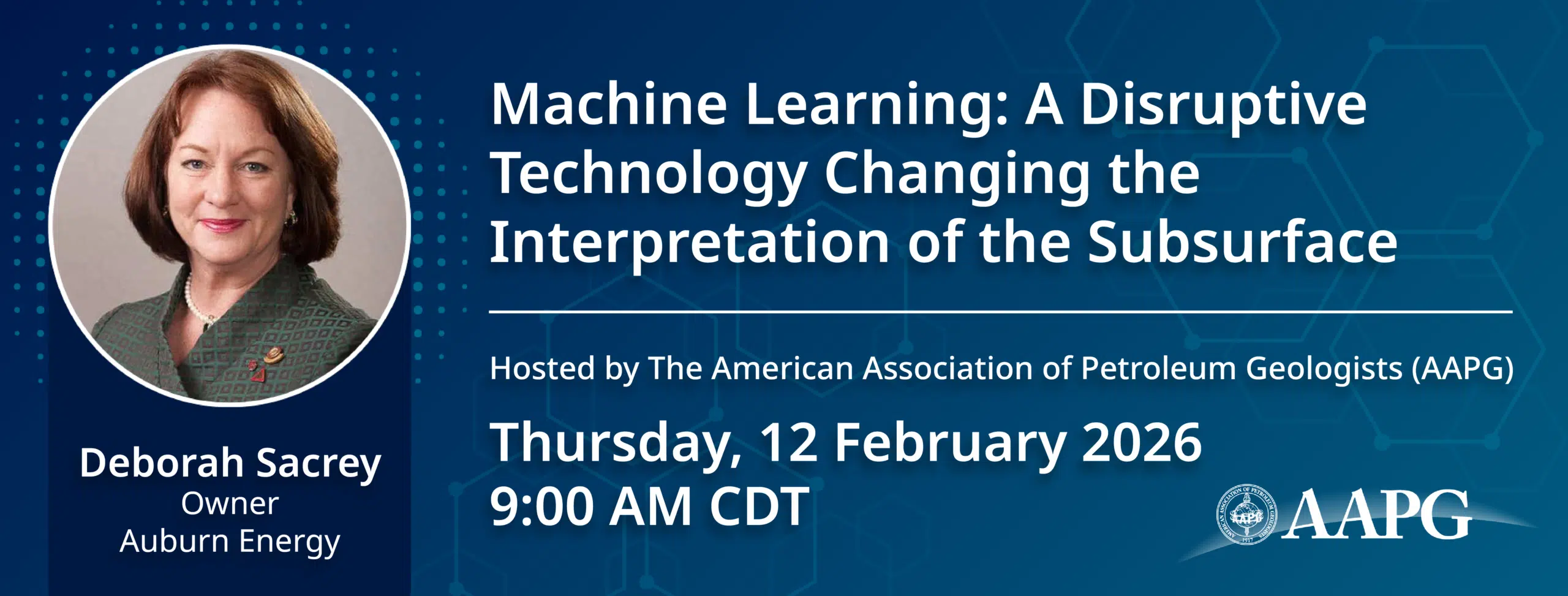


 Introduction to Machine Learning for Interpreters
 Single Trace Attributes (with certification)
 Energy Absorption and Traveling Waves (without certification)