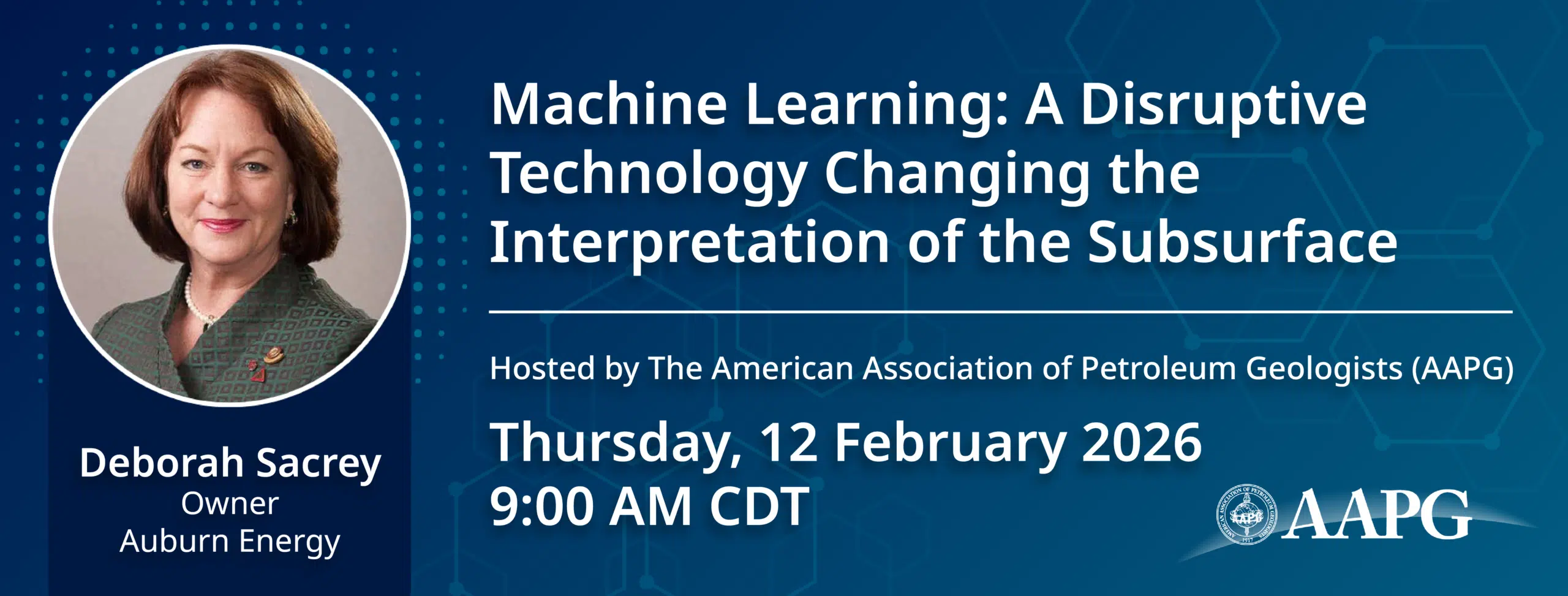
Deborah Sacrey Presents Talk on Machine Learning in AAPG Webinar

Deborah Sacrey is a geologist and geophysicist with 49 years of oil and gas exploration experience in North America and internationally. She is the founder of Auburn Energy and has been closely involved in the development and application of advanced seismic interpretation technologies, including multi-attribute neural analysis. Deborah has held numerous leadership roles within the geoscience community, including Past President of AAPG, and currently serves as Chair of the AAPG Advisory Council.

In this special session, renowned geoscientist Deborah Sacrey, founder of Auburn Energy and collaborator with Geophysical Insights, explored how multi-attribute machine learning using sample statistics was emerging as the next major disruptive technology in subsurface interpretation. Through real-world examples, she demonstrated how machine learning reduced interpretation risk and helped geoscientists extract meaningful detail beyond what conventional workflows typically revealed.

Watch the recording to learn how to:

  • Identify subtle subsurface patterns that were difficult to detect using traditional interpretation methods

  • Improve confidence in reservoir characterization by leveraging multiple seismic attributes simultaneously

  • Reduce uncertainty and risk in exploration and development decisions

  • Enhance subsurface understanding across a range of geologic settings and plays

Case histories included examples from the Permian Basin, Southern Oklahoma, and the Gulf Coast, illustrating how machine learning was reshaping interpretation workflows and enabling more confident decision-making.

I have a specific problem I'm trying to solve.ⓘ Click anywhere outside of this popup to close.

Geophysical Insights staff work in a variety of depositional environments across the globe. We're delighted to be a trusted partner in your AI journey, whatever the challenge. Please schedule a brief get-to-know you call using Calendly below, where we can dive into your specifics.

I'm considering AI for my subsurface group.ⓘ Click anywhere outside of this popup to close.

A great way to start with adopting AI for your team is to define a reasonable objective that addresses current challenges. In the case of applying the Paradise AI workbench to reservoir characterization, those challenges will be geologic and related to seismic interpretation. Here are some key questions you may want to consider as a guide to your adoption process:

  • What might be the business case for adopting AI software for seismic interpretation, e.g., speed, staff efficiencies, greater insights?
  • How well do the candidate software products align with my highest-value workflows and results, e.g., predicting lithologies, detecting faults, and identifying seismic facies?
  • Do you want your team to experience the power of AI for themselves, or do you want a service provider to generate the initial proof of concept for your team?
  • Does your company have the computing equipment and storage available to run the AI software, which can be compute-intensive and require extensive data storage?

Geophysical Insights offers initial AI adoption consultations to help address the above and other questions. Click here to schedule your 30-minute AI Discovery Call.

I'm new to AI for Reservoir Characterization.ⓘ Click anywhere outside of this popup to close.

In seismic interpretation workflows, AI is a general class of technologies that include machine learning (ML) and deep learning (DL) applications. Commercial, off-the-shelf tools like those in the Paradise AI workbench are fit-for-purpose, meaning they support specific geologic investigations. For comparison, Python is a programming environment that offers ML and DL processes. Large language models (LLMs) like ChatGPT can be used to generate Python code, among many other functions. Developers often use Python and ChatGPT together to prototype applications. In Paradise, ML, DL, and data analytic applications are pre-built and organized in workflows (ThoughtFlows®) that address out-of-the-box solutions not requiring programming, such as Stratigraphic Analysis, Lithofacies Prediction, and Fault Detection.

Scroll to Top